
APPRECIATE
How a fintech compounds interest
0 → 124K followers in 18 months.
A Fintech With
Keeda.

Every fintech on Instagram looks like a fintech on Instagram.
Tip carousels. Market update graphics. Talking heads explaining compound interest with the energy of someone who just learned what compound interest is. It's not wrong. It's just invisible. When every brand in a category sounds identical, being educational isn't a differentiator. It's background noise. Appreciate came to us as a clean slate. A new investing app helping Indians access US markets. Good product. Real ambition. No following, no content, no established voice. The brief was to build all three from scratch. We could have made better finance content than everyone else. We didn't think that was the right bet.
Entertainment that happens to be about finance.
The category was trying to educate people into caring about finance. We thought the sequence was wrong. You don't earn someone's attention by being useful first. You earn it by being interesting first, and then you get to be useful. If you entertain people consistently enough, they start associating financial literacy with enjoyment rather than obligation. That's not just a content strategy. Over time, it becomes a brand position that nobody else in the category has thought to occupy.
Not finance content that's also entertaining. Entertainment that happens to be about finance where the finance message is the twist, not the premise.
The proof is in the comment sections. Routinely, across multiple formats, people would watch a reel all the way through and discover at the end that it was an ad for Appreciate. And their response wasn't irritation. It was delight. The ad reveal was the punchline, not the interruption.
That bet required a client with the appetite for the unconventional. Appreciate had it. They challenged the work, asked harder questions, and said yes to things that looked strange on paper. A brief with that kind of energy behind it is rare. This engine is what it produces.
A system, not a calendar.
Building at that intersection required three parallel workflows running simultaneously. Each operates on a different time horizon and serves a different function.
The Newsroom
Topical reels pegged to US market news. A stock moves, a company does something interesting. We turn it into a retention-edited explainer within hours.
The Virality Lab
Ideas designed specifically to travel. Low-cost production. Not because we're cheap, but because low cost means more shots on goal. More attempts means more format discovery.
High-Conviction Bets
The pieces where we spend more. On a creator. On production quality. On a longer format. Because we have high confidence in the idea. The ones that land, land disproportionately.
Format discovery is the whole point.
The animated podcast format is the clearest example. A character called Avidit interviewing animated celebrity stand-ins on a fake podcast set. A format that could hook into any topical trigger. We built it, then waited for the right one.
The product message lands as a punchline. The audience has been entertained for 45 seconds. Then, in the last ten, they realise they've just watched an ad for Appreciate.
Find a format. Don't move on. Double down.
The Shiba Inu playing Elon Musk, laughing the signature awkward laugh from Nikhil Kamath's podcast, applied to whatever US market news was breaking that week. Same format logic. Different trigger. That one went from one reel to eight. Then ten. Each iteration slightly sharper than the last.
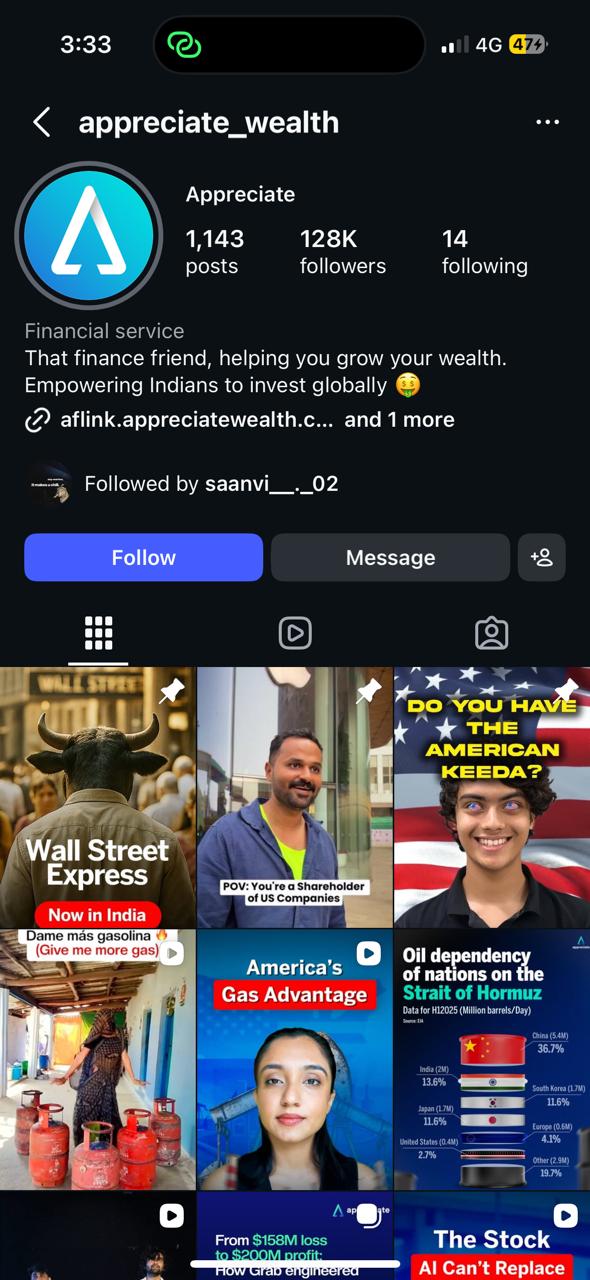
POV: You're a shareholder of US companies.
A Bombay man walks around the city acting like he has ownership stakes in every US brand he encounters. McDonald's, Apple, Nike, Hermès, Starbucks, KFC. The joke is the gap between retail investor and the way he's throwing his weight around.
The reel plays out as pure entertainment. Appreciate appears once, right at the end. The value has already been given to the viewer before the brand even shows up.
When something hits at that scale, the only correct response is to make it a series.
The Vir Saini collaboration, the 'American Keeda' series, is the clearest example of a high-conviction bet becoming a content franchise. The first reel crossed 6 million views. Certain pieces that followed crossed 10 million.
The engine absorbs new
tools without losing its
identity.
The Wall Street Express: a 50-second AI-generated piece following a stock market bull through Mumbai's local train system, all the way to Manhattan. A bull in a commuter train, glasses on, reading the paper, stepping off at Wall Street. Pixar-level characterisation, fintech substance, built entirely with GenAI tools.
It earned Appreciate a feature in a leading advertising industry publication. More importantly, it demonstrated that the engine can absorb new tools and new formats without losing its identity. Because the identity was never about a specific format.
It was always about the bet
124k+
Instagram followers from 0400k+
Total audience across platforms1M+
Views consistently on viral bets100M+
Total views over 18 monthsThat's what 18 months of content-first brand building actually produces. Not just an audience, but a warmer market for every paid rupee that follows.
This isn't a campaign. It's the founding story of a brand's voice.
A campaign has a budget, a start date, and an end date. It lives on a media plan. It represents a single, focused push to drive a number. When the plan runs out, the push stops. If you want to push again, you need a new campaign.
A content engine represents a different philosophy. It is a long-term capital investment. You are building an infrastructure. In the early months, the cost of production is high relative to the audience you reach. But as the engine runs, the audience grows, the library of content compounds, and the cost per organic view falls. Over 18 months, the client spent less on media than they would have on a single traditional TV campaign. But they built an asset that they own, that produces views every day, and that continues to recruit users without a media budget.
That's the engagement model. Not a project with a start and end date, but a compounding asset that appreciates over time.
(Yes, we intended that.)